Thursday, June 20, 2013

Time for Trees


New asphalt streets - even lines - ready for TREES !!
A new hotel - with swimming pool - in San Luis


New restaurant and disco on the Plaza


What the Poinciana trees will look like in 15 years
Back in the saddle again. I returned to mi pueblo after a wonderful US vacation to find everything in good shape. The projector and USB memory I bought in Miami were well received by Angel, who immediately put them to good use with a media show at the local. Still hard to figure why electronics are so much more expensive here – usually 150-200% more.

The big surprise was that the street paving project was near complete !! Smooth black asphalt now covers the town’s streets, replacing the rough and rutted dirt. This also means that folks will no longer throw water on the street every morning to “keep the dust down”. What it really did was make a muddy mess until the sun dried it out and the dust, once again, reigned supreme. The even put in speed bumps and painted lines.

So, now it’s time for my tree planting project to come off the back burner, where it has simmered for over a year. I’m really glad I waited, since the seedlings would have been wiped out by the construction process, which included new water and sewer lines. Construction also destroyed 13 of the sweet little “maceteros” – planting circles that lined my street. These will have to be repaired, adding an extra layer of work to the project. Because of the extra work, some of the Regidores (town council) wanted to just fill them in. This proposal was successfully fended off by Angel and I. It would be a shame to not have beautiful trees lining the streets, leaving them barren, plain and shade-less.

So, on went my contractor’s hat to do materials estimates and work-flow charts. The cost will be low – only about $150, with 6 days of the outstanding Obras crew (Don Benito, Julio and Aquilla), plus some Gringo power, who will be doing the form work and mixing planting soil. We will use rice hulls for aeration, supplemented with compost from the Eco-Banos and liquid fertilizer “biol” from the biodigesters. Synergy.

There are other subtle signs of progress in town. A locksmith has set up shop, which means San Luisians no longer have to travel to Canete for spare keys and lock repair. A sharp new restaurant and disco graces the Plaza and a fabulous new hotel is under construction. Fernando is providing plaster services for the project, which includes the FIRST swimming pool in town and 10 lovely rooms.

“My” kids came home for Fathers Day – a lovely treat. They all seem much taller and older and a bit more distant. While I’m happy that Victor and Margarita are doing so well financially in Lima, their new wealth is very much used for conspicuous consumption. They and the kids all sport new clothes. The kids had a new remote-controlled car, which put Goyo’s toy collection to the curb. They have a full-time nanny and a new home in Lima. Margarita’s comment that she was so happy to be out of “this dirty little town” did not sit well, though. Nor did her declining my offer to take the kids to the playground, because “they might get dirty”. Harumph….

Fathers Day here has two main goals : 1) place flowers on father’s grave. 2) all fathers to get as drunk as possible. The crush and commotion of flower sales outside the house was heartening, especially for the 3 flowers gals. They say Fathers Day is the biggest of the year, eclipsing Mothers Day and Easter. Victor and Fernando and guests went through a staggering 8 cases of beer, between noon and 2am. When I refused more than a token glass of beer, Fernando was shocked and said “It’s Fathers Day, Goyo. You MUST get drunk!!”. My “community integration” has its limits. Fortunately, the following Monday is considered a holiday – out of deference to the majority of fathers who would not make it to work anyway.

Wednesday, June 19, 2013

Training Model for Cocina Mejorada


introducing.............Cocina Mejorada Training Model

NEW !! from the PC R&D Center in San Luis de Canete, comes the latest innovation in Cocinas training tools …..


The revolutionary Cocina in a BOX !!

An exact ¼ scale model of the popular Cocina Mejorada, with true scale adobes, bricks, losa, plastic vapor barrier and chimney.


No longer must Volunteers and socios dirty their hands to learn how to build a Cocina. This model, made of sturdy, all-natural wood and triply can recreate the construction process ANYWHERE. Build it, take it apart and re-build it – its durable and non-toxic !! Fun for the entire family.


Ships and stores in its own handy shipping box – goes anywhere with ease.


GET YOURS TODAY !!

Friday, June 7, 2013

US Vacation


Members of the Princeton Class of 1973 - returned to "The Best Old Place of All"


Room Mates reunited

With good dog Ollie in Central Park

Times Square - a long way from rural Peru
I fully expected some “culture shock” when I visited the US. And to feel like a visitor in my own country. Aside from the delight of having toilet paper, toilet seats, soap and hand towels in all bathrooms and hot water at every shower, and very little litter, I felt none of either. I felt very much at home and quite comfortable in my homeland.

My dear sister Darcy was the perfect NYC hostess, whipping up superb dinners and guiding me to the most precious parts of “her” Central Park. With the added accompaniment of Goodest Doggie Ollie, we travelled the lesser known trails of this magnificent Park, which has been restored to the grandeur of earlier times. Even more remarkable, is that this bucolic green paradise sits amid skyscrapers on all sides. It really has the feel of a small town park, though I expect that the many people who knew Darcy and Ollie is due to her vivacious and out-going personality – Park staff included.

We also went to see the new George Plimpton movie at Lincoln Center. I had forgotten just how many adventures George had taken in. He lived in a rare world of celebrity and spontaneity, which pushed both his ex-wives away. I was stuck by how much I resonated with his spirit and life choices. “I suppose you could say I’m a collector of experiences.” I’ll take a slice of that pie, ala mode, please.

Times Square had an alien feel to it, which was perfect, since we went to see the new Star Trek movie there. This was the first Imax, 3-D movie I’ve ever seen. A bit off-putting at first, I gradually found myself a part of the movie – a voyeur, lurking alone at very close range. The rest of the audience, and indeed the world, had simply disappeared. More than a few smiles and heart-tugs, as the characters stayed absolutely true to the personas of the original Trek TV series.

Suddenly, it was time to board the train to Princeton. It’s been 15 years since my last visit, which made the “going back” all the sweeter. There were many other returning alumni on the train, several already sporting Reunions garb. On the small PJ&B shuttle train that goes right into the University, the preponderance of orange had grown dramatically. Despite the profusion of new buildings on campus, the place still felt familiar and welcoming, as I navigated to our 40th reunion site by Dod Hall. And then, the real joy began.

This was not a reunion of handshakes, but of long, sincere man-hugs. It was not a reunion of “Hi, good to see you”’s, but of real conversations, connections and discussions. I was instantly reminded of what extraordinary men and dear friends I went to college with. PG Randall is teaching robotics and shaking up the teaching world. Jim Kelsey is engaged in some brilliant writing and metal art. Chris Leach has started an online diabetes magazine. Each of these, and many more, excited my imagination and elevated awe of my peers.

The sheer logistics of these Reunions is awesome. Thousands of returning alumni are fed, well and on-time. Reunion tents and refreshments and under-graduate reunion crews spring up all over the campus. Crews of students and grounds-keepers sweep the entire place to pristine every morning. And it is all gone after 3 days. The 40th camp was no exception and we enjoyed a brilliant dinner on the shores of Lake Carnegie at the Boathouse.

A special treat was a lunch with my fellow Cottage Club section. These guys and my room-mates were my closest friends in college. Ed O’Lear did a brilliant job of arranging this private time for us. The place looked great and really felt like home. We were treated to a Skype session with our old club manager, Matty Glinka, now in his 90’s and too frail to attend in person. He also created DVDs, complete with a customized cover of each of us at graduation, with eclectic videos of graduation and the fabled “Boot Classic” blow-pong match.

The cultural phenomenon known as the “P-Rade” has always been intriguing to me. It’s a parade of strolling alumni and marching bands, winding its way through the campus. The route is lined by alumni in descending age order. Led by the oldest graduates and ending with the graduating class, it’s like watching your life pass by in reverse. In earlier years, I noted the general condition of each class and the increasing range of preservation with age. This year, I found myself paying VERY close attention to the classes 10 and 20 years ahead of me, as if to glean some information about my future.

Tired Good-Byes were said and I headed back to New York and Miami, where I was joined by my lovely friend Chris Clark. We did some shopping for Angel, my Peruvian community partner, visited the Coral Castle, which I last saw 50 years ago, enjoyed some outstanding Cuban and seafood, and watched airplanes take-off and land at the MIA. I was really glad for my Spanish abilities in a town where I heard very little English. Every conversation at the Home Depot, for example, was en EspaƱol.

All my flights and security screenings were uneventful and smooth, including a change of planes in Bogota, Columbia. Lima was just as dirty and noisy as ever and I found a large smile consuming my face, as I approached San Luis. It was good to go home, and good to return home. 

More photos at:


Friday, May 17, 2013

Canadians, eh ??


Teaching "losa" making


"Papa" Joe from the Rainbow of Hope of Canada

Visiting a Home Depot style hardware store in Chincha

Ismael learning Goyo's tricks

Similar flags
I went to Chincha, about 1 hour south of here, to train a Canadian NGO in Cocina construction. These folks are doing lots of good in that area – building a school and replacing dirt roofs with concrete. They have also taken the “bottle bulb” idea and multiplied it. While there is nothing like actually building one for training, this visit gave me the idea to create a ¼ scale model, which can be used to give a 3D experience. The adobes and bricks are wooden blocks, so the structure can be re-created over and over. Progress is good.

On a sad note: someone cut a few of the fire hose supports on the swings at the Viviendas #2 playground. I was able to repair quickly, but am disappointed that this type of wretched vandalism has raised it head in my quiet little town. The good part about the #1 playground by the Muni is that it is highly visible and locked up at night. Spray paint graffiti also appeared on a nice wall below the big cell phone tower. It was quickly repainted.

I’m excited about my upcoming visit to the US for my 40th Princeton Reunion. I’m girded for some culture shock. And the pleasure of seeing many of my dear friends and classmates – some of the finest men on the planet.

Saturday, May 11, 2013

ECPA Renewable Energy Conference


Teaching about solar panels and pumps


Lecturing on composting toilets

Demonstrating the biodigester

Converting a propane stove to use bio-gas

Basking in the glow of a "bottle bulb"
Well, it’s been a busy week in San Luis de Canete, my home town, out here on the edge of the desert prairie. The ECPA Renewable Energy conference has come and gone. Over 30 PCVs and community partners got a good basis education in renewable energy topics, including climate change, solar panels, passive solar, biodigesters, improved cook stoves, bottle bulbs and composting toilets. I was pleased that we presented not only classroom instruction, but hands-on demonstrations, as well. The Duenas family at the Goat Farm were perfect hosts. They served up some beautiful, classic Canete dishes : Sopa Seca and papas Huancaina, Loma Saltado and Seca Canetano. We also enjoyed yogurt and cheese samples and play time with the goats and Odie dog. We rounded out the work with some touristy trips to Castle Unanue and the Cerro de Oro. Everyone, from the farm to the bus driver to the El Dorado hotel performed brilliantly (and on time) to make the conference a success.

The only glitch in the schedule was that it ended the day before Mothers Day, when buses are full, transporting sons and daughters home to visit with their Moms. This is one of the biggest holidays in Peru – eclipsed only by Easter and Anniversary. Vast bundles of flowers were sold in front of the cemetery. All of them destined for the crypts of dead Moms. Last year, I offended Margarita by getting her flowers – just not done here. I got invited to two dinners and attended both, which was not appreciated by my digestive apparatus. Still and all, a wonderfully sweet day – so many folks scurrying around town to honor their Moms. And a nice day to remember my Mom and the MANY gifts she gave me.

Thursday, April 25, 2013

Turks Seat - Latrine Upgrade

Pit latrine - not a happy place to poop

Forms and reinforcement wire
The finished "tube"- the top rim will be painted


Add a cover and the Turk Seat is complete
 In the annex of San Antonio, there are some nasty latrines. These are simple pit latrines - a hole in the ground, with a concrete slab with a hole in it and sheet metal building structure. The problem is that not everything that is supposed to go in the hole, goes there. Since these are used by more than one family, no one seems to take responsibility for cleaning the poop, pee or vomit that don't make it into the hole.

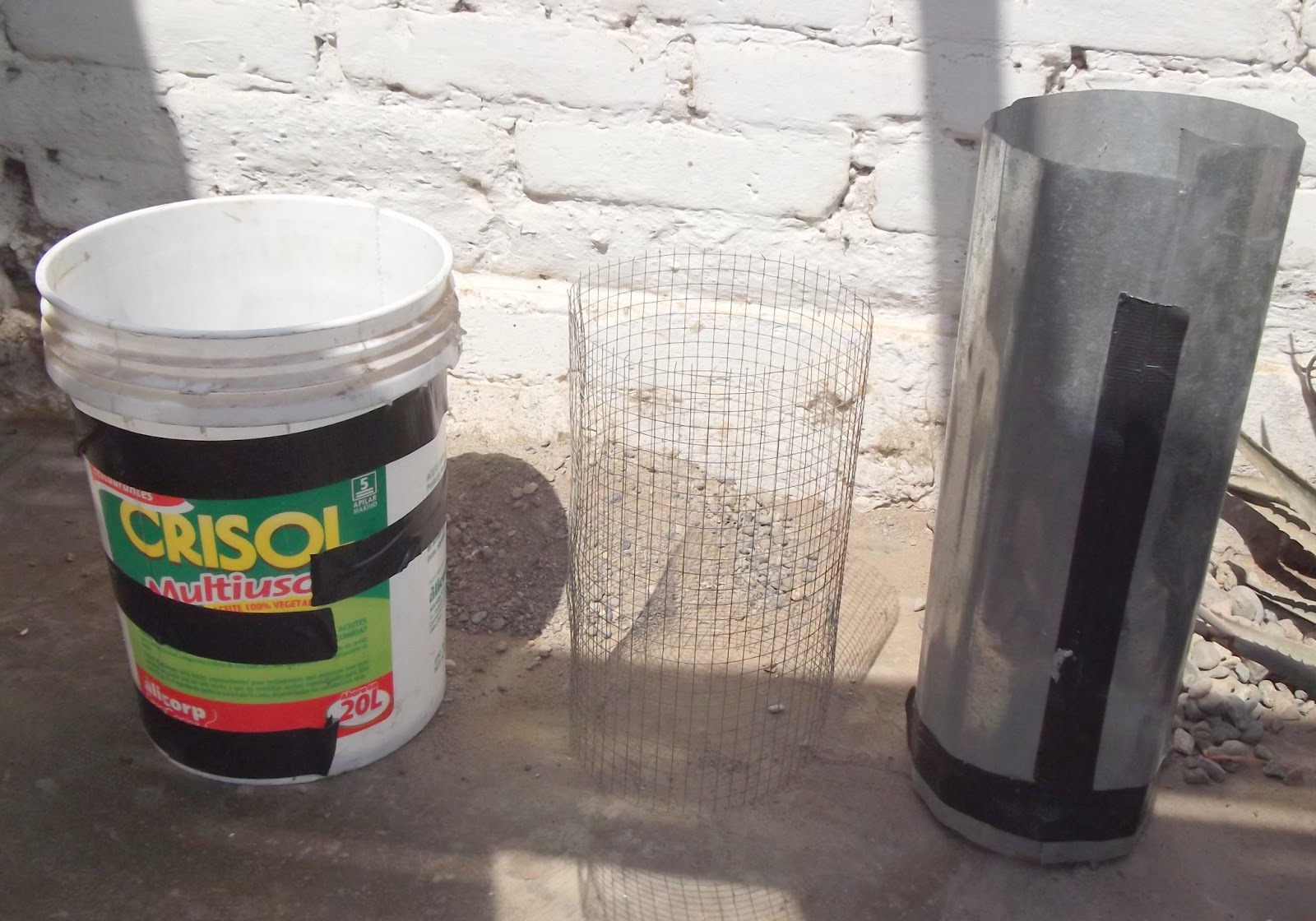
My solution is the simple Turks Seat - a small concrete "tube" that funnels everything into the hole and gives a clean seat, instead of squatting over the hole. The fabrication is easy and cheap - about $2 each.

You take a 5 gallon plastic bucket - usually 12" diameter and 14" high - and make an 8" diameter tube (at least 14" high) out of sheet metal or layers of cardboard. Center the tube in the bucket (oiling the sides will aid release) and secure it in place by filling with sand or rocks. Make a 10" diameter x 13" tube of wire mesh and insert that in the gap. Fill with concrete, let set for 2 days, flip over and pop concrete ring out of bucket. The top can be further smoothed by rubbing on a fine plaster mixture and painted, or covering with a plastic toilet seat. The interior could also be smoothed and painted to aid cleaning and sanitation.

Thursday, April 18, 2013

Amazonas Vacation


At the magnificent Gocta waterfalls


With Brian at the ancient Kuelap fort
One of the “perks” of Peace Corps service is 48 days of vacation over the 2 year term. And a “foreign” vacation , at that. I’ve been to the deep desert at Nasca and the jungle at La Merced. This time, I headed to the northern mountain state of Amazonas and the small city of Chachapoyas.

I started with 3 days in Lima, working with my PC friends Will, Dan and Brian. We were tasked with producing a master document for Cocinas Mejoradas (improved cookstoves) with the accumulated wisdom and experience of past projects. This will be used in future WASH trainings and by others wanting to create these life and energy saving stoves.

Then Brian and I jumped on the luxury ITTSA bus to Chiclayo. It’s an overnight 12 hour trip, but the accomadations make it very comfortable , even sleep-able. The seats are basically what you’d find in 1st Class on an overseas flight – each one folds down into a bed, with individual headsets and TV screen. The cabin is spacious, clean, with good AC and in-flight snacks.

After a nice breakfast, we boarded a not-so-nice day trip bus to Pedro Ruiz. Leaving the rice basket of Lambayeque, we passed one of the areas huge, man-made pyramids, crafted of adobe brick, but well worn by hundreds of years of rain. Heading into the Andes, we crossed at the one of the low passes into the Amazon basin and a world of green rice fields along the river bottom and small hillside farms, travelling long hours between towns. We stopped only for lunch at a mountain restaurant, before passing through the nasty basin town of Bagua Grande at dusk. A collectivo – kind of a shared taxi - whisked us to Chachapoyas, passing huge landslides in the night.

The Villayas hotel is by far the nicest PC hotel in Peru – beautiful rooms with the BEST hot water shower I’ve had in over a year, for about US$13.50 a night. Chacha is an old colonial town, noted for its decorative balconies and fine woodwork. Food was world-class – while a tad expensive by Peruvian standards, still cheap (breakfast $4 and dinner $10) compared to US. The biggest surprise was the abundance of seafood, especially ceviche, high in the mountains and far from the sea. Amazonas beef was outstanding. It was wonderful to see so many of my friends from Peru 18 there – Brian and Sara, Chris and Baber, and celebrating Chris’ 24th birthday in fine style.

I signed up for the tour trip to Kuelap, the nearby ancient mountain-top fortress. Getting there was half the adventure – 3 hours on one-lane dirt mountain roads, twisting and turning past many mud and rock slides. One had so damaged the road that the passengers had to get out and help push the van through. And looking down 500-1000 ft drop offs on the side of the road, with no guard rails. Arriving at the new visitor center – under construction – we hiked about 30 minutes up to the fort, feeling the 7000 ft altitude all the way. The locals all chew coca leaf, so I gave it a try. It’s like chewing a bunch of tree leaves – not tasty at all. Once the leaves are macerated into a plug, a small amount of lime (the mineral, not the fruit) is added to release the active ingredient. While I didn’t feel much of a lift, it did make my mouth quite numb.

The fort is impressively massive and imposing. Its walls were never breached and it’s easy to see why – only 2 very narrow entrances in the 80 ft outer wall. Even more amazing to learn that the limestones were all quarried about 10 miles away. The unique architecture of the site is the circle – virtually all structures were round, to withstand the frequent earthquakes in the area. Kuelap was a rather small residence, but its population grew dramatically during festivals or times of attack from the jungle people. The festivals included mostly animal sacrifice, but some human, as well. The fort’s location was strategic, with longs views in all directions, down each of the 4 approach valleys and of the field studded lower mountains. The stonework is impressive, but not as fine as Muchu Pichu or the construction I saw at Huaytara.

On the trip back to Chacha, we stopped to see some of the mountain-side burial tombs in the surrounding cliffs. Like the Wari, the Chachapoyans put a LOT of effort into honoring the dead. They were placed in funeral bundles with gifts for the next life and set into small caves and breaches in the vertical limestone cliffs. Some were placed in beautiful and ornate wooden sarcophagi. Unlike my Wari burial ground, these cliffs have offered more protection to the bodies and artifacts.

The next day’s journey was to the magnificent waterfall(s) at Gocta. Again, it was a long, 3 hour ride just to get to the small gateway town of San Pedro, where we picked up our guide, Don Ricardo. The 3 hour hike is hard, especially if not altitude acclimated – next time I would take a horse. The trail is beautiful and unspoiled. We passed a couple of coca fields that had been sprayed and killed by DEA, as well as bunches of wild orchids and mountain springs. And more burial cliffs. The lush jungle trails were full of exotic fruit trees and huge ferns.

The Gocta Falls is really two falls, upper and lower, which combined are the 3rd highest in the world. We hiked to the base of the upper fall, but had views of the lower falls along the way, as well as spectacular vistas of the surrounding mountains and valleys. The lower falls hike is even longer and harder, though it is possible to go in on one and out on the other. At the upper base, we found a unique fern tree, growing to 50 ft , and a deafening roar of water and rush of displaced air , as the water thundered to the rocks and water pools at the base. The river then travels about 200 yds, to the top of the lower falls. The moisture creates a micro climate of ferns and odd , brilliant green landscape.

For the return trip to Lima, I took a direct bus trip of 26 hours, not nearly as comfortable as the trip in, but tolerable and scenic. Most PCVs travel on the more comfortable night buses, which deny the scenic trip through the Andes pass.

Now, it’s back to work, readying for the Renewable Energy conference I’m hosting for 30 PCVs and community partners at the Goat Farm, designing a skate-park and engineering a new concrete toilet seat for nearby pit latrines.