Friday, May 17, 2013

Canadians, eh ??


Teaching "losa" making


"Papa" Joe from the Rainbow of Hope of Canada

Visiting a Home Depot style hardware store in Chincha

Ismael learning Goyo's tricks

Similar flags
I went to Chincha, about 1 hour south of here, to train a Canadian NGO in Cocina construction. These folks are doing lots of good in that area – building a school and replacing dirt roofs with concrete. They have also taken the “bottle bulb” idea and multiplied it. While there is nothing like actually building one for training, this visit gave me the idea to create a ¼ scale model, which can be used to give a 3D experience. The adobes and bricks are wooden blocks, so the structure can be re-created over and over. Progress is good.

On a sad note: someone cut a few of the fire hose supports on the swings at the Viviendas #2 playground. I was able to repair quickly, but am disappointed that this type of wretched vandalism has raised it head in my quiet little town. The good part about the #1 playground by the Muni is that it is highly visible and locked up at night. Spray paint graffiti also appeared on a nice wall below the big cell phone tower. It was quickly repainted.

I’m excited about my upcoming visit to the US for my 40th Princeton Reunion. I’m girded for some culture shock. And the pleasure of seeing many of my dear friends and classmates – some of the finest men on the planet.

Saturday, May 11, 2013

ECPA Renewable Energy Conference


Teaching about solar panels and pumps


Lecturing on composting toilets

Demonstrating the biodigester

Converting a propane stove to use bio-gas

Basking in the glow of a "bottle bulb"
Well, it’s been a busy week in San Luis de Canete, my home town, out here on the edge of the desert prairie. The ECPA Renewable Energy conference has come and gone. Over 30 PCVs and community partners got a good basis education in renewable energy topics, including climate change, solar panels, passive solar, biodigesters, improved cook stoves, bottle bulbs and composting toilets. I was pleased that we presented not only classroom instruction, but hands-on demonstrations, as well. The Duenas family at the Goat Farm were perfect hosts. They served up some beautiful, classic Canete dishes : Sopa Seca and papas Huancaina, Loma Saltado and Seca Canetano. We also enjoyed yogurt and cheese samples and play time with the goats and Odie dog. We rounded out the work with some touristy trips to Castle Unanue and the Cerro de Oro. Everyone, from the farm to the bus driver to the El Dorado hotel performed brilliantly (and on time) to make the conference a success.

The only glitch in the schedule was that it ended the day before Mothers Day, when buses are full, transporting sons and daughters home to visit with their Moms. This is one of the biggest holidays in Peru – eclipsed only by Easter and Anniversary. Vast bundles of flowers were sold in front of the cemetery. All of them destined for the crypts of dead Moms. Last year, I offended Margarita by getting her flowers – just not done here. I got invited to two dinners and attended both, which was not appreciated by my digestive apparatus. Still and all, a wonderfully sweet day – so many folks scurrying around town to honor their Moms. And a nice day to remember my Mom and the MANY gifts she gave me.

Thursday, April 25, 2013

Turks Seat - Latrine Upgrade

Pit latrine - not a happy place to poop

Forms and reinforcement wire
The finished "tube"- the top rim will be painted


Add a cover and the Turk Seat is complete
 In the annex of San Antonio, there are some nasty latrines. These are simple pit latrines - a hole in the ground, with a concrete slab with a hole in it and sheet metal building structure. The problem is that not everything that is supposed to go in the hole, goes there. Since these are used by more than one family, no one seems to take responsibility for cleaning the poop, pee or vomit that don't make it into the hole.

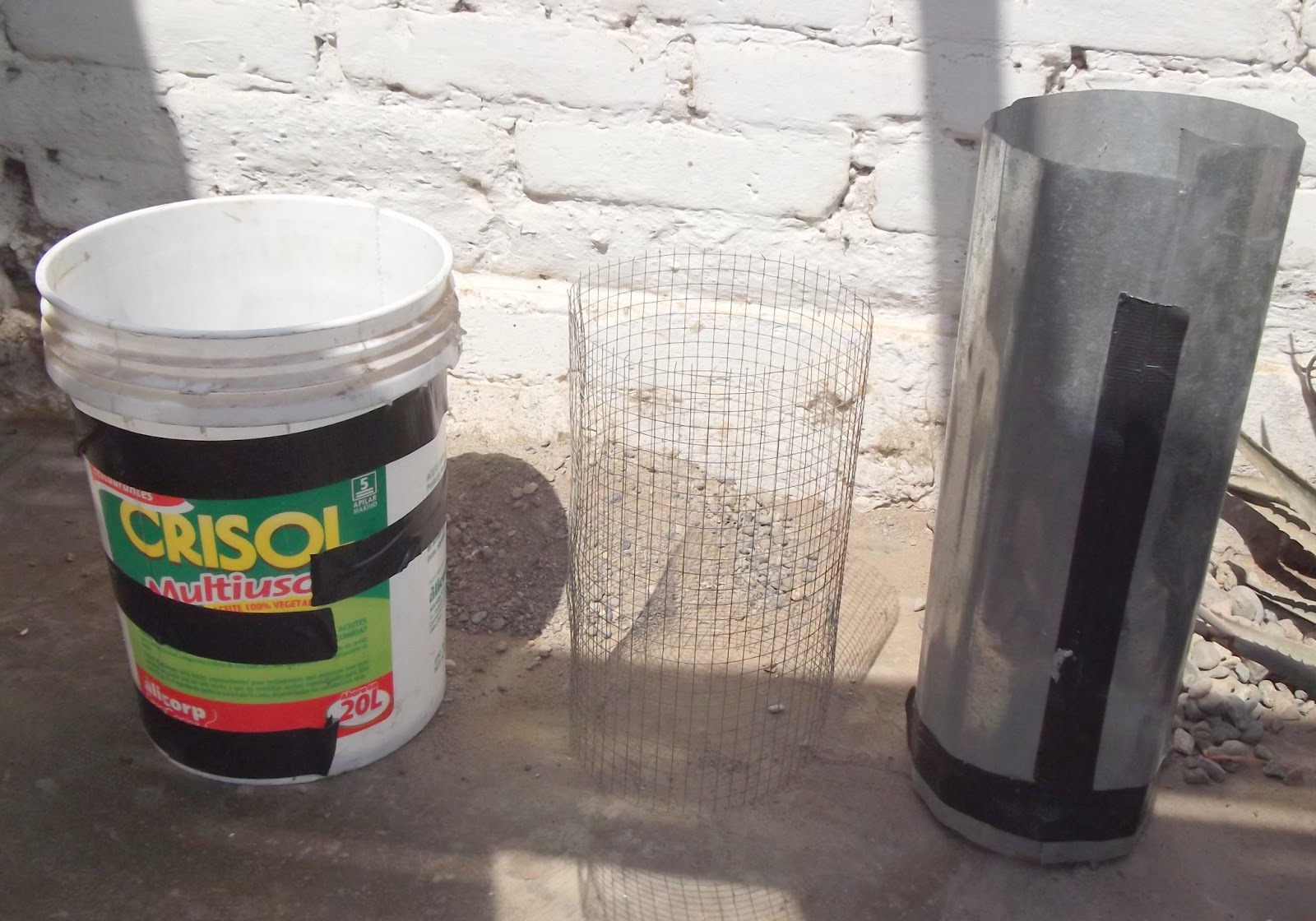
My solution is the simple Turks Seat - a small concrete "tube" that funnels everything into the hole and gives a clean seat, instead of squatting over the hole. The fabrication is easy and cheap - about $2 each.

You take a 5 gallon plastic bucket - usually 12" diameter and 14" high - and make an 8" diameter tube (at least 14" high) out of sheet metal or layers of cardboard. Center the tube in the bucket (oiling the sides will aid release) and secure it in place by filling with sand or rocks. Make a 10" diameter x 13" tube of wire mesh and insert that in the gap. Fill with concrete, let set for 2 days, flip over and pop concrete ring out of bucket. The top can be further smoothed by rubbing on a fine plaster mixture and painted, or covering with a plastic toilet seat. The interior could also be smoothed and painted to aid cleaning and sanitation.

Thursday, April 18, 2013

Amazonas Vacation


At the magnificent Gocta waterfalls


With Brian at the ancient Kuelap fort
One of the “perks” of Peace Corps service is 48 days of vacation over the 2 year term. And a “foreign” vacation , at that. I’ve been to the deep desert at Nasca and the jungle at La Merced. This time, I headed to the northern mountain state of Amazonas and the small city of Chachapoyas.

I started with 3 days in Lima, working with my PC friends Will, Dan and Brian. We were tasked with producing a master document for Cocinas Mejoradas (improved cookstoves) with the accumulated wisdom and experience of past projects. This will be used in future WASH trainings and by others wanting to create these life and energy saving stoves.

Then Brian and I jumped on the luxury ITTSA bus to Chiclayo. It’s an overnight 12 hour trip, but the accomadations make it very comfortable , even sleep-able. The seats are basically what you’d find in 1st Class on an overseas flight – each one folds down into a bed, with individual headsets and TV screen. The cabin is spacious, clean, with good AC and in-flight snacks.

After a nice breakfast, we boarded a not-so-nice day trip bus to Pedro Ruiz. Leaving the rice basket of Lambayeque, we passed one of the areas huge, man-made pyramids, crafted of adobe brick, but well worn by hundreds of years of rain. Heading into the Andes, we crossed at the one of the low passes into the Amazon basin and a world of green rice fields along the river bottom and small hillside farms, travelling long hours between towns. We stopped only for lunch at a mountain restaurant, before passing through the nasty basin town of Bagua Grande at dusk. A collectivo – kind of a shared taxi - whisked us to Chachapoyas, passing huge landslides in the night.

The Villayas hotel is by far the nicest PC hotel in Peru – beautiful rooms with the BEST hot water shower I’ve had in over a year, for about US$13.50 a night. Chacha is an old colonial town, noted for its decorative balconies and fine woodwork. Food was world-class – while a tad expensive by Peruvian standards, still cheap (breakfast $4 and dinner $10) compared to US. The biggest surprise was the abundance of seafood, especially ceviche, high in the mountains and far from the sea. Amazonas beef was outstanding. It was wonderful to see so many of my friends from Peru 18 there – Brian and Sara, Chris and Baber, and celebrating Chris’ 24th birthday in fine style.

I signed up for the tour trip to Kuelap, the nearby ancient mountain-top fortress. Getting there was half the adventure – 3 hours on one-lane dirt mountain roads, twisting and turning past many mud and rock slides. One had so damaged the road that the passengers had to get out and help push the van through. And looking down 500-1000 ft drop offs on the side of the road, with no guard rails. Arriving at the new visitor center – under construction – we hiked about 30 minutes up to the fort, feeling the 7000 ft altitude all the way. The locals all chew coca leaf, so I gave it a try. It’s like chewing a bunch of tree leaves – not tasty at all. Once the leaves are macerated into a plug, a small amount of lime (the mineral, not the fruit) is added to release the active ingredient. While I didn’t feel much of a lift, it did make my mouth quite numb.

The fort is impressively massive and imposing. Its walls were never breached and it’s easy to see why – only 2 very narrow entrances in the 80 ft outer wall. Even more amazing to learn that the limestones were all quarried about 10 miles away. The unique architecture of the site is the circle – virtually all structures were round, to withstand the frequent earthquakes in the area. Kuelap was a rather small residence, but its population grew dramatically during festivals or times of attack from the jungle people. The festivals included mostly animal sacrifice, but some human, as well. The fort’s location was strategic, with longs views in all directions, down each of the 4 approach valleys and of the field studded lower mountains. The stonework is impressive, but not as fine as Muchu Pichu or the construction I saw at Huaytara.

On the trip back to Chacha, we stopped to see some of the mountain-side burial tombs in the surrounding cliffs. Like the Wari, the Chachapoyans put a LOT of effort into honoring the dead. They were placed in funeral bundles with gifts for the next life and set into small caves and breaches in the vertical limestone cliffs. Some were placed in beautiful and ornate wooden sarcophagi. Unlike my Wari burial ground, these cliffs have offered more protection to the bodies and artifacts.

The next day’s journey was to the magnificent waterfall(s) at Gocta. Again, it was a long, 3 hour ride just to get to the small gateway town of San Pedro, where we picked up our guide, Don Ricardo. The 3 hour hike is hard, especially if not altitude acclimated – next time I would take a horse. The trail is beautiful and unspoiled. We passed a couple of coca fields that had been sprayed and killed by DEA, as well as bunches of wild orchids and mountain springs. And more burial cliffs. The lush jungle trails were full of exotic fruit trees and huge ferns.

The Gocta Falls is really two falls, upper and lower, which combined are the 3rd highest in the world. We hiked to the base of the upper fall, but had views of the lower falls along the way, as well as spectacular vistas of the surrounding mountains and valleys. The lower falls hike is even longer and harder, though it is possible to go in on one and out on the other. At the upper base, we found a unique fern tree, growing to 50 ft , and a deafening roar of water and rush of displaced air , as the water thundered to the rocks and water pools at the base. The river then travels about 200 yds, to the top of the lower falls. The moisture creates a micro climate of ferns and odd , brilliant green landscape.

For the return trip to Lima, I took a direct bus trip of 26 hours, not nearly as comfortable as the trip in, but tolerable and scenic. Most PCVs travel on the more comfortable night buses, which deny the scenic trip through the Andes pass.

Now, it’s back to work, readying for the Renewable Energy conference I’m hosting for 30 PCVs and community partners at the Goat Farm, designing a skate-park and engineering a new concrete toilet seat for nearby pit latrines.

Friday, March 29, 2013

Ministry of Culture


Semana Santa ended in a flurry. Saturday, I treated myself to a day at the beach and seafood – ceviche and Mahi fingers - at Cerro Azul, a pleasant little beach resort, with great seafood, 15 minutes up the coast. I took the packed combi up – it was a good day for the beach. All the restaurants were packed, so I wound up sharing a table with a couple that I took for Americans, from their perfect English greetings. Not so – Peruvians from Lima, both educated in the US. Conversation was mostly about gun control in the US. Not much of an issue here, as few Peruvians own guns. They prefer to have armed guards outside their homes and on neighborhood patrols. They gave me a ride home in their new BMV SUV. There are clearly two Perus. I prefer the less-Americanized version.

The big meeting with the Ministry of Culture was beyond a success. Angel and I rode the bus up to Lima. The Ministry of Culture is quite an imposing building and also houses a cultural and art museum. After the requisite security check, we ascended to the opulent 8th floor offices where we were joined by Francesca, the archeologist who will be leading a Stanford dig on the Cerro de Oro this winter. Our team met with the Vice Minister and the Director of Archeology to discuss permission to construct access gates, eco-banos and visitor trails on the Cerro, which is a designated archeological site. I was delightfully surprised when they not only approved of our project, but offered to assist. The Ministry will refurbish the large concrete site marker, provide posters and materials discouraging looting and provide training and workshops – better than any of us had hoped for. Now we wait for the paperwork.

In the meantime, I’ve arranged for two teachers from the Colegio Mixto to attend a wonderful conference, sponsored by the US Embassy, to teach best methods of teaching English. All the HS students have English classes, but only 2 hours per week – not really enough for them to be near fluent. The current methods are all “call and response” repetition and the gals are excited to learn some tools to make their classes more interesting and effective. The workshop will be held at an old convent, right on the ocean, just south of Lima. It’s also quite a treat for them to get expense paid time away from San Luis and meet other teachers from all over Peru.

I’d like to attend with them, but I’ll be working with Brian and Will – two of my favorite PCVs and friends – to write a “master” document for Cocina Mejorada (improved cookstove) project planning and construction. I’ve built 15 of these here in San Luis. They replace the practice of cooking INDOORS over an open fire and eliminate the smoke and back problems from stooping. We’ll be taking all the bits that various PCVs have written to form a cohesive, practical document.

A group of Small Business Development PCVs and their community partners from Arequipa came by to find out about the Cerro de Oro project. They have similar, but not as spectacular archeological sites in their area and are interested to learn how we structured our project. And of course an impressive tour of the Cerro. Sadly we found two new holes – very recently dug.

I’m also enjoying my consulting role on solar and biodigester projects, helping other PCVs through the process. Doing these projects early in my service has given me a good chance to follow-up and revisit the projects and see any post-installation problems.

After, the Cocinas gig, I’m taking it on the road for my 3rd vacation – this time up north to Chachapoyas in Amazonas, where several of my PCV friends live – 22 hours of bus from Lima. The Quelap ruins and Gocta waterfalls (2nd largest in S America) await. Only 6 days, as I must return to set-up the big ECPA renewable energy conference I’m hosting here in San Luis at the goat farm.

The big local news is ASPHALT !! Our town’s streets are about to get paved. What a delightful and clean change that will be. But, to get there , we must endure street closures, noise and all sorts of prep work. Huge front-end loaders and dump trucks rule the streets and shake the ground – like mild earthquakes. After the paving is done, I’ll be coordinating a community effort to plant beautiful Poinciana trees – my Florida friends know these well. My only fear is that they grow slowly – it will be a few years before they are sturdy enough to withstand much abuse. I’m counting on civic pride to negate vandalism.

Speaking of quakes, there have been 7 in Peru in the last week. All of them in the 4-5 range and 5-10 second range, just the way we like ‘em. They keep those big, destructive >7 shakers from happening. I’ve felt two – a 4.6 about 20 miles away and a bigger 4.9 about 150 miles off. Very similar to my time in Southern California.


Friday, March 15, 2013

Semana Santa - Easter


Easter and Holy Week are the biggest events on the Catholic calendar here in Peru - Bigger than Christmas and almost as festive as the week-long anniversary celebrations. It is the one time when EVERYBODY goes to church. There are large, slow processions, carrying icons amid ranks of adorably dressed-up boys and girls, accompanied by bands of slightly off-key musicians. I’ve still not determined if it is the poor quality of the instruments or lack of talent. Though they do play with great spirit. Nor have I fathomed the reason for starting the parades at 10pm, which is just about my bed-time. And, of course, what religious celebration is complete without fireworks and beer-drinking circles ?

For me, the best part of Easter is that “my” kids, Amir, Santi and Camila are visiting from Lima. I have missed them so very much. They all seem much taller and more adult than when they left. There was much news to exchange and balloons to blow up. And, of course, there was the raiding my snack stash. I enjoy the many other kids in my life here – the goat farm tribe, Vidal’s seven and the playground troops, but these three are special.

I did attend Maundy Thursday mass with the family. The church was PACKED - and it's twice the size of the old one. Lots of flowers, everybody dolled up and a real air of excitement. The priests rip through the service, like it was a race - I caught maybe 10%, but did get to light off some fireworks. Having the only long handled lighter around gives me privileges.

At least, Peru does not suffer from the commercialization of Easter that the US seems to be experiencing. It always brings to mind….. Peeps - the most inane and dreadful of all confections. So odd that there is almost a cult around the nasty critters. Not surprising, yet sad that vendors have co-opted yet another holiday and turned it into a time for vapid consumerism. Maybe appropriate, though, that Ishtar go back to its pagan roots :
http://www.guardian.co.uk/commentisfree/belief/2010/apr/03/easter-pagan-symbolism

Then, I was up late talking with the "family" here. It was a fascinating glimpse of a whole new world for me -mining - and another chance to practice my beer drinking avoidance protocol. I've mastered the "short pour" and the "fake cold" and the "quick pass" - all of which are needed to avoid getting sloshed. The fake cold allows me to use my own glass, which also allows me not to have to slug down the shared glass and pass on occasion. The short pour involves shaking the bottle into the glass to produce a huge head and little beer. I’m getting really good at all.


Victor is doing SO well at his job. He is doing what he trained for - repairing motors and electrical devices for Chinalco, the giant Chinese mining company.  They have 5 big mines here - all doing horrible things to the people and environment. From just one mine, they figure to take $20B of copper, silver and molybdenum. A private commercial airliner shuttles parts and people every day from China. Story at :
http://www.guardian.co.uk/world/2012/dec/20/chinese-mining-peru-corporate-responsibility

Victor seems to be aware of this and there have been protests at the company HQ. But, the money is so big , nobody seems to care. He has gotten 2 promotions since last June when he started and is now making "more than 50K soles" a year (>US$20K), which is like winning the lottery to him. When first met him, he was working at a hardware store in San Luis for 45 soles a day, 4 days a week (less than $4K/yr). Margarita is also making double what she made for the same work as a salesperson at the same appliance store where she worked here in Canete. Needless to say, this has created quite a change and "nouveau riche" attitude. The kids have a nanny, which fulfills Margarita's desire to spend as little time as possible with them. There is even talk of buying a car. The Chinese are selling cars here like hotcakes, but even the cheapest new one would be half his annual salary. I was delighted that I could keep up with most of the conversation, even though speech was fast and slurred.


Wednesday, March 13, 2013

Man with a Plan

Overall plan for Cerro de Oro project

Site plan for tourist center
The summer heat has finally broken and Paradise returns to Canete. Cool nights and warm, sunny days, with sea breezes and no chance of rain. The season change also brings FRUIT !! While mangoes are fading, figs (fresh and dried), dates, grapes, cherimoya and lucama abound. And avocados – the green ones get packed off to the States, leaving the tree ripened ones here. The famous Canete mandarin oranges – the main fruit crop here – will be coming soon. They are already in the market as “mandarino verde” – not quite ready for my taste, but very popular with the locals. This year will be the first production from the new, large passion fruit orchard. I’m looking forward to that.

But, even in Paradise, there is work to be done. The big paving project is underway. ALL of the urban streets are being paved with asphalt. I can not say what a big deal this is. Until now, only the main street – and only part of that – has been paved. All other streets are dirt. And very rough. Every morning folks come out early and wet them down, creating a muddy mess until the sun dries them out again. They rattle the bolts on every car and moto-taxi and throw dust in the air when dry. The main entry road is the very worst – an unsightly welcome to our little town. But, all this will soon change. Folks are already swelling with pride at being a “real” town.

Even better, as soon as the paving is done, I’ll be coordinating the planting of Poinciana trees in the little round planters that dot the streets. They are empty right now, as an earlier planting of fichus trees flopped. They were the wrong trees – needing lots of water – and the poor clay soil was not amended or fertilized and there was no protection or support for the seedlings. We’ll be using a native tree – the same ones that grace the Plaza. Poinciana is familiar to my S Florida friends and has lush green foliage and brilliant red flowers. It uses less water and puts down a deep tap root. We’ll also add some compost from the Eco-Banos , rice husks for aeration, and some liquid fertilizer from the biodigesters. I love synergy. The seedling will be tied to four sturdy wooden supports, which will also serve to fend off careless moto-taxis and reckless kids. The only down-side is that the trees grow slowly. But, they should be spectacular in 10-15 years.

The playgrounds have spawned yet another project : a skateboard park. The local skateboarders saw the park and have started a campaign – including a nicely done YouTube video –

to get a place where they can safely skate, without bothering folks in the Plaza and marking up the park benches and sidewalks. So, the dynamic duo of Goyo and Angel ride once again.

The project to protect and develop tourism for the Cerro de Oro burial ground and ruins continues. The USAID grant proposal is complete, after many rounds of revision and budget crunching. Francesca, the Stanford archeologist, has been crucial to getting this done. She is young, but has contacts in high places. One last meeting with the Vice-Minister of Culture to get our permissions in order. Fortunately, between Francesca’s friends at the Ministry and my USAID contacts, I think we have it locked. I’m really looking forward to a good solid construction project, building the museum and doing all the plumbing and electric. Plus, the excitement of participating in a real archeology dig.

Aside from the trees and skatepark and Cerro de Oro project, my service is shifting to kind of a consulting gig. Many of my comrades are starting projects now and my experience is in high demand. I’m also doing lots of writing for PC publications and training for the newer PCVs. I’ll be hosting a big ECPA Renewable Energy conference here in May and there tons of details – housing, food, transport, events to arrange. A bit like being a travel agent. Thank goodness the goat farm is a ready-made meeting and training site. Mama and Chanel will be cooking up a storm – on bio-gas and Cocina Mejorada, no less. Side trips to the castle and Cerro are planned to add some spice.